
Table of Contents
- Understanding Sensitive Aging Skin
- Gentle Anti-Aging Ingredients That Actually Work
- Retinol Alternatives for Sensitive Skin
- Building a Skincare Routine for Mature Skin
- Ingredients to Avoid and How to Patch Test
- The Role of Sunscreen and Lifestyle in Aging Skin
- Conclusion: Choosing the Best Skincare for Sensitive Aging Skin
- Frequently Asked Questions
Last Updated: September 13, 2026
Understanding Sensitive Aging Skin
Finding the best skincare for sensitive aging skin starts with one uncomfortable truth: the products that promise the fastest results are usually the ones most likely to leave your face red, tight, and stinging. At Flawless Skin Co., we hear this constantly from women in their 40s, 50s, and 60s who have cycled through serums that worked brilliantly for a week and then triggered a reaction.
Sensitive aging skin is skin that has become both thinner and more reactive over time, meaning it needs active ingredients delivered gently rather than aggressively. That combination, reduced resilience plus a lower irritation threshold, is what makes this category so difficult to shop for.
What Happens to Sensitive Skin as It Ages
Collagen production declines, cell turnover slows, and the skin's outer barrier thins with age (pubmed.ncbi.nlm.nih.gov). The result is a complexion that loses elasticity and hydration while simultaneously tolerating less. A product that felt fine at 35 can sting at 55, and it isn't your imagination.
Why Standard Anti-Aging Products Often Irritate
Most anti-aging formulas are built around high concentrations of acids and retinoids. Those ingredients work, but they demand a resilient barrier. When the barrier is already compromised, they strip it further, causing the redness, flaking, and stinging that send so many people back to square one.
Gentle Anti-Aging Ingredients That Actually Work
The best anti-aging ingredients for reactive skin are the ones that support the barrier while gradually improving tone and texture. According to American Academy of Dermatology guidance on aging skin, consistent daily care matters far more than any single "miracle" ingredient.
Barrier Repair: Ceramides, Peptides, and Niacinamide
Ceramides are lipids that fill the gaps between skin cells, and they are the foundation of barrier repair. Peptides signal the skin to support its own collagen, working gradually rather than by force. Niacinamide calms visible redness and supports hydration at the same time, which is why it appears in so many formulas designed for reactive complexions.
Antioxidants and Hydration: Vitamin C and Hyaluronic Acid
Vitamin C is an antioxidant that defends against daily environmental stress, but the pure form is acidic and often irritating. Gentler derivatives such as tetrahexyldecyl ascorbate and sodium ascorbyl phosphate deliver similar benefits without the sting. Pair them with hyaluronic acid, which draws water into the skin and reduces transepidermal water loss.
Ingredient |
Primary Job |
Best For |
Watch Out For |
|---|---|---|---|
Ceramides |
Rebuild the barrier |
Dry, reactive skin |
Needs consistent daily use |
Peptides |
Support collagen |
Early fine lines |
Results build over months |
Niacinamide |
Calm redness, hydrate |
Uneven tone |
High concentrations can tingle |
Vitamin C derivatives |
Antioxidant defense |
Discoloration |
Pure ascorbic acid irritates |
Hyaluronic acid |
Hold water in skin |
Dehydration |
Layer under a moisturizer |
Retinol Alternatives for Sensitive Skin
Retinol alternatives for sensitive skin deliver smoother texture and softer fine lines without the peeling that makes traditional retinol so difficult to tolerate. The key is understanding why each alternative is gentler, because the mechanism determines how you should use it and how long you should wait before judging results.
How Retinol Works, and Why It Stings
Prescription retinoids and over-the-counter retinol work by binding to retinoic acid receptors in skin cells, which accelerates cell turnover and stimulates collagen production. The problem is speed. Classic retinol converts to retinoic acid in the skin within hours, and that sudden surge of turnover is what causes the redness, flaking, and stinging known as "retinization." On a thinned, reactive barrier, that surge is more than the skin can buffer.
Bakuchiol: The Most Studied Plant Alternative
Bakuchiol is a meroterpene extracted from the seeds of the babchi plant (Psoralea corylifolia). It appears to influence some of the same gene-expression pathways as retinol without binding directly to retinoic acid receptors, which is the leading explanation for its lower irritation profile. Most practitioners find it takes longer to show visible change, often 8 to 12 weeks rather than 4 to 6, but it rarely triggers the peeling cycle. It layers well with niacinamide and ceramides, and it does not make skin significantly more sun-sensitive the way retinoids can.
Peptides: The Gentlest Path to Firmer Skin
Peptides are short chains of amino acids that act as signaling molecules. Rather than forcing turnover, they tell the skin to support its own collagen and elastin production. Copper peptides, matrixyl, and argireline are common examples. Peptides are the easiest alternative to layer with other products because they do not compete for the same receptors, and they carry essentially no irritation risk for most people. The trade-off is pace: results build over two to three months, not two to three weeks.
Gentle Retinoids and Encapsulated Retinol
If you want to try an actual retinoid, ask about the newer gentle forms. Encapsulated retinol wraps the active in a lipid shell that releases it gradually into the skin, smoothing the turnover spike that causes flaking. Retinaldehyde sits one conversion step closer to retinoic acid than retinol, so it works faster but is also more likely to irritate. Adapalene is a synthetic retinoid available over the counter that is generally better tolerated than tretinoin, though it is still a true retinoid and not a substitute for a barrier-first approach.
Alternative |
Mechanism |
Typical Time to Results |
Irritation Risk |
|---|---|---|---|
Bakuchiol |
Modulates retinol-like gene pathways |
8-12 weeks |
Low |
Peptides |
Signal collagen support |
8-12 weeks |
Very low |
Encapsulated retinol |
Gradual retinoic acid release |
6-10 weeks |
Moderate |
Retinaldehyde |
One step from retinoic acid |
4-8 weeks |
Moderate to high |
Adapalene |
Synthetic retinoid |
4-8 weeks |
Moderate to high |
How to Sequence Alternatives in a Routine
Pick one alternative, not two, and run it for a full 12 weeks before adding anything else. Bakuchiol and peptides can be used in the morning or evening. Encapsulated retinol and retinaldehyde belong in the evening only, and always over a moisturizer during the first month. Do not stack a retinol alternative with exfoliating acids on the same night; the combination defeats the purpose of choosing a gentler active in the first place.
Building a Skincare Routine for Mature Skin
A workable skincare routine for mature skin follows one rule: fewer products, introduced slowly. Four steps done consistently beat ten steps that keep your skin in a permanent state of recovery.
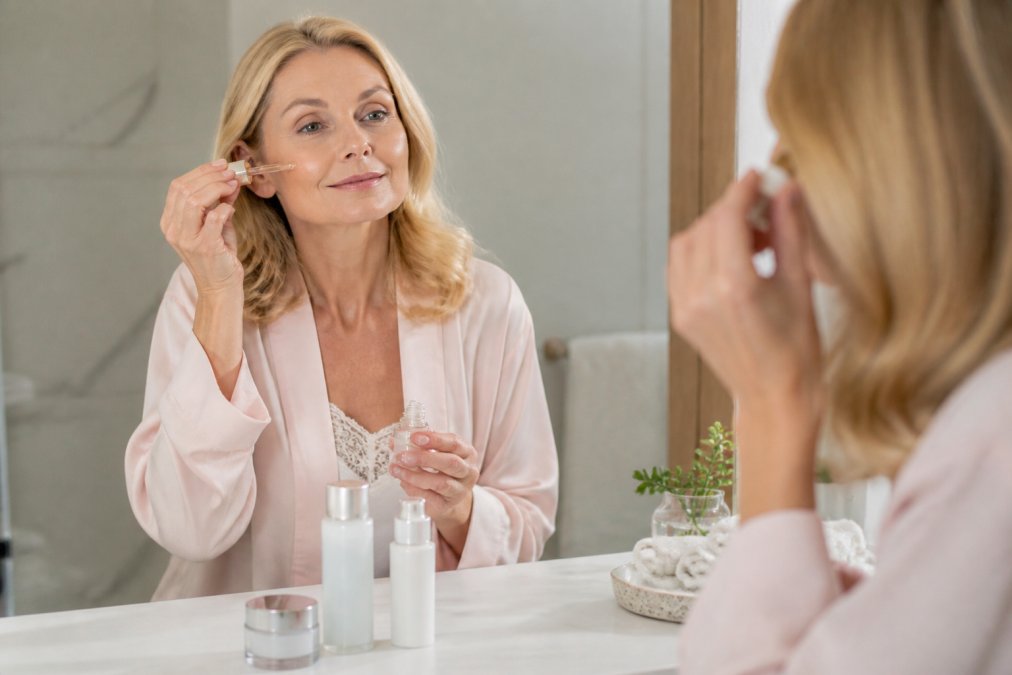
- Morning: rinse with lukewarm water, apply an antioxidant serum, then a moisturizer, then sunscreen.
- Evening: cleanse with a fragrance-free cream cleanser, apply your treatment of choice, then seal with a barrier moisturizer.
- Weekly: skip exfoliation entirely at first; add one gentle session only once your skin has been calm for two weeks.
Keep the routine stable for at least six weeks before judging results. Cell turnover and barrier repair are slow processes, and switching products every fortnight guarantees you never learn what actually works.
Ingredients to Avoid and How to Patch Test
Fragrance, essential oils, drying alcohols, and physical scrubs are the four most common triggers for reactive skin. None of them improve aging, and all of them can undo weeks of progress in a single application.
A patch test is a simple check where you apply a small amount of product to a discreet area and wait before using it on your face. Apply a dime-sized amount behind your ear or on your inner forearm, leave it for 24 hours, then repeat for two more days. If there is no redness, itching, or swelling after 72 hours, begin using it on your face every other day.
The Role of Sunscreen and Lifestyle in Aging Skin
Sunscreen is the most effective anti-aging product you will ever use, and for sensitive skin the formula matters as much as the protection level. Choose a broad-spectrum product with a sun protection factor of 30 or higher, and look for mineral filters like zinc oxide or titanium dioxide, which sit on top of the skin rather than absorbing into it. Mineral formulas are less likely to sting on application, which matters when your barrier is already reactive. Reapply every two hours outdoors, and remember that incidental exposure, walking to the car, sitting near a window, drives most visible aging over a lifetime.
The Skin Cancer Foundation guidance on daily sunscreen use recommends broad-spectrum protection every day, not only at the beach.
Menopausal Skin Changes: The Factor Most Guides Skip
Most skincare articles treat aging as a slow, linear process. For women, it is not. Estrogen decline during perimenopause and menopause accelerates skin thinning, reduces collagen density, and lowers sebum production, which together make the barrier more fragile and more reactive almost overnight. A common pattern is skin that tolerated the same routine for a decade suddenly stinging in the same products. If that describes you, the fix is usually not a new active, it is a richer moisturizer, a cream cleanser instead of a foaming one, and a full month of patience before changing anything else.
How Sleep, Stress, and Diet Reach the Barrier
Lifestyle factors matter more than most product labels admit, and the mechanism is worth understanding. During deep sleep, the body releases growth hormone that supports skin repair and collagen synthesis; short sleep shifts the balance toward cortisol, which breaks down collagen and increases water loss through the skin. Chronic stress does the same thing through sustained cortisol elevation, and it also slows barrier recovery after an irritation event. Diet enters through inflammation and hydration: adequate protein supports collagen building blocks, omega-3 fats support the lipid barrier, and alcohol and high-sugar intake are associated with increased glycation, which stiffens collagen over time. None of this replaces sunscreen or a barrier moisturizer, but it explains why two people with identical routines can see very different results.
Conclusion: Choosing the Best Skincare for Sensitive Aging Skin
The best skincare for sensitive aging skin is the one your barrier can tolerate long enough to show results. That means ceramides and peptides over harsh acids, bakuchiol over aggressive retinoids, and sunscreen every single morning.
Flawless Skin Co. builds small-batch, science-backed formulas for exactly this situation, with premium ingredients chosen for people who want visible results without the irritation cycle. Our high-performance serums and lotions are designed to support graceful aging, and customers frequently tell us their skin glows from the first use. Add Flawless Skin Co. to your routine and give your complexion the calm, consistent care it has been asking for.
Frequently Asked Questions
What ingredients should I avoid in anti-aging products for sensitive skin?
Avoid high concentrations of retinol, alpha-hydroxy acids (AHAs), beta-hydroxy acids (BHAs), and synthetic fragrances. These can trigger redness, stinging, and peeling. Also steer clear of denatured alcohol and essential oils like citrus or peppermint. Instead, look for fragrance-free, hypoallergenic formulas with ceramides, peptides, and niacinamide. Always patch test new products on your inner forearm for 24 hours before applying to your face.
Are retinol alternatives effective for sensitive aging skin?
Yes. Bakuchiol, a plant-derived compound, has been shown to improve fine lines and skin elasticity without the irritation of retinol. Peptides and gentle retinoids like retinyl palmitate also support collagen production with less risk of sensitivity. These alternatives work gradually, so you may need 8-12 weeks to see noticeable results. They are a good option if traditional retinol causes redness or peeling.
How do I build a skincare routine for mature, sensitive skin?
Start with a gentle, fragrance-free cleanser. Follow with a hydrating toner or essence, then a serum containing niacinamide or peptides. Apply a rich moisturizer with ceramides to repair the barrier. In the morning, finish with a broad-spectrum sunscreen with SPF 30 or higher. Introduce active ingredients like bakuchiol or vitamin C slowly, one at a time, to avoid irritation. Consistency matters more than using many products.
How can I treat wrinkles without causing skin irritation?
Focus on barrier repair and hydration first. Use ingredients like hyaluronic acid, ceramides, and peptides to plump skin and reduce the appearance of fine lines. For wrinkles, try bakuchiol or low-dose retinyl palmitate, applying every other night. Always follow with a moisturizer. Sunscreen is critical: unprotected UV exposure breaks down collagen and worsens wrinkles. A gentle, consistent routine yields better results than aggressive treatments.